
| <- 社交账号登录。或禅世界会员登录。【论坛使用帮助】 |

数百报纸在协同性的社论中谴责川普对媒体的攻击
Hundreds Of Newspapers Denounce Trump's Attacks On Media In Coordinated Editorials

The Boston Globe's logo as seen through the windows across from the new location of the Globe in Boston. The paper's editors coordinated a campaign defending a free press in editorials.
Joseph Prezioso/AFP/Getty Images
Updated at 10:04 a.m. ET
More than 300 news publications across the country are joining together to defend the role of a free press and denounce President Trump's ongoing attacks on the news media in coordinated editorials publishing Thursday, according to a tally by The Boston Globe.
The project was spearheaded by staff members of the editorial page at the Globe, who write: "This relentless assault on the free press has dangerous consequences. We asked editorial boards from around the country – liberal and conservative, large and small — to join us today to address this fundamental threat in their own words."
Marjorie Pritchard, the Globe's deputy managing editor of the editorial page who spearheaded the effort, told NPR's Morning Edition, "This editorial project is not against the Trump administration's agenda. It's a response to put us into the public discourse and defend the First Amendment."
She said the reason to publish the editorials now was "because the press needs to have a voice on this. ... We've done individual editorials, but I think it's, there is some strength in numbers of just defending a constitutionally enshrined pillar of democracy."
Editorials are typically written by opinion writers and are considered separate from organizations' news coverage. NPR, for example, has a separate "opinion" category. But unlike many media outlets, NPR does not have an editorial board, and did not take part in Thursday's coordinated effort.
In a column called "A Free Press Needs You," The New York Times' editorial board writes that "Criticizing the news media — for underplaying or overplaying stories, for getting something wrong — is entirely right. News reporters and editors are human, and make mistakes. Correcting them is core to our job. But insisting that truths you don't like are 'fake news' is dangerous to the lifeblood of democracy. And calling journalists the 'enemy of the people' is dangerous, period."
Small publications across the country participated as well.
Charlie Smith of The Columbian-Progress of Columbia, Miss., wrote that newspapers"are the ultimate friend of the people. To attack them is to attack our own selves."
"Americans may not like the news they see or hear but they should not hold that against those who report it," TriCorner News from The Lakeville Journal Co. in Lakeville, Conn., writes. "In short, don't shoot the messenger."
Other newspapers supported the mission but declined to take part. The San Francisco Chronicle's editorial page editor, John Diaz, pointed to previous editorials in the paper denouncing attacks on the press, but said "answering a call to join the crowd, no matter how worthy the cause, is not the same as an institution deciding on its own to raise a matter."
The Slidell Independent in Slidell, La., participated in the coordinated editorial — to criticize the endeavor and defend the president. "The national media still doesn't know what to do with President Trump, so now they are crying to the American people about the names they have been called," the paper wrote. "Maybe if they focused on doing their jobs instead of worrying about their precious reputation the American people might start getting real, honest journalism again."
Jack Shafer argues in Politico that the current effort "is sure to backfire."

SIMON SAYS
Opinion: Calling The Press The Enemy Of The People Is A Menacing Move
"It will provide Trump with circumstantial evidence of the existence of a national press cabal that has been convened solely to oppose him. When the editorials roll off the press on Thursday, all singing from the same script, Trump will reap enough fresh material to whale on the media for at least a month."
Trump has made bashing the news media — "horrible, horrendous people" — a staple of his candidacy and a constant throughout his presidency. He has tweeted at least seven times since June referring to the news media in some way as the "enemy of the people."
On Thursday morning, the president returned to the topic. "THE FAKE NEWS MEDIA IS THE OPPOSITION PARTY," Trump wrote on Twitter, adding that it is "pushing a political agenda or just plain trying to hurt people."
 Donald J. Trump
✔@realDonaldTrump
THE FAKE NEWS MEDIA IS THE OPPOSITION PARTY. It is very bad for our Great Country....BUT WE ARE WINNING!
44.2K
27.9K people are talking about this
Donald J. Trump✔@realDonaldTrump
There is nothing that I would want more for our Country than true FREEDOM OF THE PRESS. The fact is that the Press is FREE to write and say anything it wants, but much of what it says is FAKE NEWS, pushing a political agenda or just plain trying to hurt people. HONESTY WINS!
30.6K
22.4K people are talking about this
In a poll released Tuesday by Quinnipiac University, a slim majority of Republican respondents, 51 percent, said they consider the news media the "enemy of the people" Thirty-six percent of Republicans thought the media were "an important part of democracy."
The question asked, "Which comes closer to your point of view: the news media is the enemy of the people, or the news media is an important part of democracy?" Overall, 65 percent of U.S. voters say the media are an important part of democracy, according to Quinnipiac.
The poll asked respondents if they were concerned that the president's attacks would lead to violence against people who work in media. Fifty-two percent of respondents said they were not concerned, while 44 percent said they were.
Some reporters themselves have said they increasingly feel at risk of violence.
" 'I hope you get raped and killed,' one person wrote to me just this week," MSNBC's Katy Tur said on air recently. " 'Raped and killed.' Not just me, but a couple of my female colleagues as well." She added that the letter ended with "MAGA," short for Trump's slogan, "Make America Great Again."
Earlier this month, CNN's Jim Acosta urged White House press secretary Sarah Sanders to say the news media are not the enemy, which she would not do.
Acosta tweeted a video on July 31 that he said was from a Trump rally, featuring Trump supporters giving the middle finger to the camera and one person yelling, "stop lying."
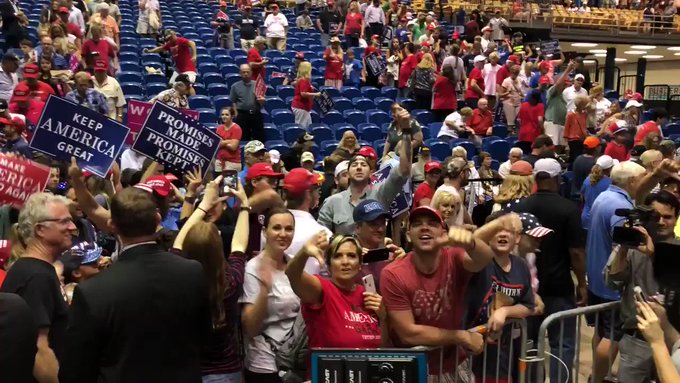
 Jim Acosta
✔@Acosta
Just a sample of the sad scene we faced at the Trump rally in Tampa. I’m very worried that the hostility whipped up by Trump and some in conservative media will result in somebody getting hurt. We should not treat our fellow Americans this way. The press is not the enemy.
97.7K
105K people are talking about this
Some reporters say they're receiving heightened security measures when covering Trump rallies, according to Politico, though many news outlets don't comment publicly about such matters.
Thirty-one journalists in the U.S. have been attacked so far in 2018, according to the U.S. Press Freedom Tracker. In June, five employees were killed in the Capital Gazette newsroom in Annapolis, Md. A man who had a longstanding grudge with the publication has been charged with multiple counts of murder.
Trump responds after hundreds of newspaper editorials criticize his attacks on the press
President Trump is not the first leader to label journalists as “enemies of the people” and creators of “fake news.”
Hundreds of newspaper editorial boards across the country answered a nationwide call Thursday to express disdain for President Trump’s attacks on the news media, while some explained their decision not to do so. The same morning, the president tweeted that the “fake news media” is the “opposition party.”
The editorials came after the Boston Globe’s editorial board called on others to use their collective voice to respond to Trump’s war of words with news organizations in the United States.
Trump has labeled the news media “the enemy of the American people” and called much of the coverage “fake news.”
“Today in the United States we have a president who has created a mantra that members of the media who do not blatantly support the policies of the current US administration are the ‘enemy of the people,’” the Globe’s op-ed board wrote in an editorial published online Wednesday. “This is one of the many lies that have been thrown out by this president, much like an old-time charlatan threw out ‘magic’ dust or water on a hopeful crowd.”
[Why the media shouldn’t go to ‘war’ with Trump]
The Globe’s editorial board made the appeal last week, urging newspaper editorial boards to produce opinion pieces about Trump’s attacks on the media. These boards, staffed by opinion writers, operate independently from news reporters and editors.
As The Washington Post’s policy explains, the separation is intended to serve the reader, “who is entitled to the facts in the news columns and to opinions on the editorial and ‘op-ed’ pages.”
The Globe reported Thursday that more than 300 of them obliged.
Trump responded to the editorials on the same morning, tweeting that the Globe is “in collusion with other papers on free press” and that much of the media is “pushing a political agenda.”
Donald J. Trump✔@realDonaldTrump
The Boston Globe, which was sold to the the Failing New York Times for 1.3 BILLION DOLLARS (plus 800 million dollars in losses & investment), or 2.1 BILLION DOLLARS, was then sold by the Times for 1 DOLLAR. Now the Globe is in COLLUSION with other papers on free press. PROVE IT!
26.9K
16.3K people are talking about this
Donald J. Trump✔@realDonaldTrump
There is nothing that I would want more for our Country than true FREEDOM OF THE PRESS. The fact is that the Press is FREE to write and say anything it wants, but much of what it says is FAKE NEWS, pushing a political agenda or just plain trying to hurt people. HONESTY WINS!
50.7K
36.5K people are talking about this
A month after taking the oath of office, Trump labeled the news media “the enemy of the American people.” In the year that followed, a CNN analysis concluded, he used the word “fake” — as in “fake news,” “fake stories,” “fake media” or “fake polls” — more than 400 times. He once fumed, the New York Times reported, because a TV on Air Force One was tuned to CNN.
Then last week, at a political rally in Pennsylvania, Trump told his audience that the media was “fake, fake disgusting news.”
“Whatever happened to honest reporting?” Trump asked the crowd. Then he pointed to a group of journalists covering the event. “They don’t report it. They only make up stories.”
In response, the Minneapolis Star Tribune’s editorial board wrote:
Let’s start with a fundamental truth: It is and always has been in the interests of the powerful to dismiss and discredit those who could prove a check on their power. President Donald Trump is not the first politician to openly attack the media for fulfilling its watchdog role. He is, perhaps, the most blatant and relentless about it.
To this president, the journalist’s time-honored role in a democracy is meaningless. Reporters present a fact-finding counter to the fanciful narrative Trump spins daily.
And the Houston Chronicle:
What makes Trump’s undermining of the press worse is that it’s not taking place in bureaucracy’s backrooms. Trump’s insults directed at reporters and news organizations, and his threats to limit press access and freedoms, are front and center at news conferences, at rallies, on Twitter. And they’re incessant.
Not only do they pose a danger to journalists’ safety — history tells us mere bias can progress to harsh words, to bullying and even to violence if society comes to accept the escalating forms of ridicule as normal — but there’s a more insidious threat. Trump’s broad brush undermines the collective credibility of thousands of American journalists across the country, and the world, who make up the Fourth Estate — so called for its watchdog role over the other three branches of government.
And also the Denver Post:
We believe that an informed electorate is critical to Democracy; that the public has a right to know what elected officials, public figures and government bureaucracies are doing behind closed doors; that journalism is integral to the checks and balances of power; and that the public can trust the facts it reads in this newspaper and those facts coming from the mainstream media.
Trump is a difficult politician to cover. His tweets and factually inaccurate statements frequently put him at loggerheads with the media. In a vacuum void of his outlandish statements, some of Trump’s policies would earn more straightforward media coverage. It has become a destructive cycle where the media covers Trump’s words and instead of self-reflection following scathing media reports, Trump cries fake news.
It’s a dangerous cry coming from the White House.
The Miami Herald’s editorial board called on Trump to end the war:
We all — as citizens — have a stake in this fight, and the battle lines seem pretty clear. If one first comes successfully for the press as an “enemy of the American People,” what stops someone for coming next for your friends? Your family? Or you?
Not even President Richard Nixon, whose original “enemies list” of the 20 private citizens he hoped to use his public office to “screw” included three journalists, tried to incite violence against reporters. While stewing privately about Bob Woodward and Carl Bernstein as “enemies . . . trying to stick the knife right in our groin,” not even Nixon tagged the lot of us, Soviet-style, as “enemies of the people.” Nor did even he dare to take on the idea that our free press is worth protecting.
However, some newspapers decided not to run editorials on the issue, including The Washington Post. This newspaper’s editorial board has previously responded to Trump’s attacks on news organizations, but Editorial Page Editor Fred Hiatt said Saturday that the board would not participate in the organized response.
Neither did the Los Angeles Times.
Or the San Francisco Chronicle.
The Chronicle’s editorial page editor, John Diaz, wrote that “It’s not that we take issue with the argument that Trump’s assault on the truth generally, and his efforts to diminish the free press specifically, pose a serious threat to American democracy.” But, he said, the newspaper values independence — a sentiment that was shared by the Los Angeles Times.
“The Globe’s argument is that having a united front on the issue — with voices from Boise to Boston taking a stand for the First Amendment, each in a newspaper’s own words — makes a powerful statement,” Diaz wrote. “However, I would counter that answering a call to join the crowd, no matter how worthy the cause, is not the same as an institution deciding on its own to raise a matter.”

President Donald Trump. (Carolyn Kaster/AP Photo)
The Globe’s call represents one side of a debate about how the media should view and respond to the president’s splenetic attacks on the press — or whether it should do anything at all.
Washington Post Executive Editor Martin Baron, who has responded directly to Trump’s attacks, said the paper’s reporting on the president is not a result of hostility. Baron told the Code Media conference in California: “The way I view it is, we’re not at war with the administration; we’re at work. We’re doing our jobs.”
Baron told interviewers that The Post would have approached a Hillary Clinton administration with the same aggressive reporting.
But at least one newspaper said that the president is not its primary concern.
The editorial board for the Capital Gazette in Annapolis wrote that the newspaper is more concerned with how its community sees it.
“It’s not that we disagree with concerns about the president’s language in speeches and on social media,” the op-ed board said. “We noted with regret the hurtful nature of his remarks last month calling most journalists dishonest even as we attended funerals for five friends and colleagues killed in the June 28 attack on our newsroom.
“We’re just not coordinating with other news organizations because the president’s opinion, frankly, is just not that important to us. We are far more concerned about what this community thinks of us.”

【声明】:禅世界论坛尊重言论自由,任何人可讨论佛法、政经、生活和科技等话题。言论发表前请根据常识和法规自审。论坛管理员和版主有权删除任何不当内容。使用本论坛即表示接受【禅世界论坛规则】。【论坛使用帮助】。 【禅世界免责声明】。
【Chanworld.org】2017.06.06-2021.04.30-2025.04.10-MG-RM
